Chateau de Cheverny Golf Course, Cheverny
The golf course of the Château Cheverny has been constructed in the 142 hectares of the historic hunting grounds of the château.
Good value inn in Beaugency
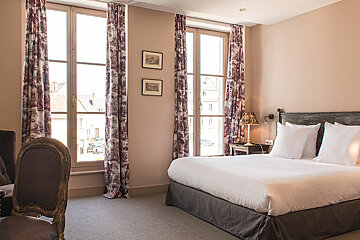
This small inn in the centre of the lovely village of Beaugency offers 29 well-presented rooms and has recently added an outdoor swimming pool in the grounds. It's a pretty place to stop and offers very good value.
Each of the well appointed rooms are soundproofed, with their own individual heating and air conditioning systems. They each have a free minibar, a television, a bathroom and free Wi-Fi. There are also some options for connecting family rooms to make a large suite.
For dining there is a restaurant and a brasserie. Both provide authentic, seasonal food.
At the restaurant, you will find a cosy and refined dining room, with a menu combining traditional dishes with simple style. An extensive wine list will accompany your meal. Showcasing many of the local wines from the Loire Valley.
The brasserie also is based on regional dishes in a less formal setting. Here, you can also sample the local wines with your meal.
The golf course of the Château Cheverny has been constructed in the 142 hectares of the historic hunting grounds of the château.
Built in the grounds of the Château de l'Epinay, this 18-hole golf course extends over 67 hectares. The 5,790-metre course has slightly wavy greens and small rivers, ponds and streams. A reasonably easy course with the Martin Hawtree signature.
Windsurfing, Stand-Up paddleboarding, Catamaran sailing and Kayak tours ranging from half day to several days can be taken with this canoe and kayak company based on the Ile Millocheau in Saumur.
Located on the banks of the river Loire with Sancerre hill in the background, this course in the midst of century-old trees, ornamented by natural water hazards, is considered one of the most attractive golf courses in the centre of France. An 18-hole course with bunkers and water hazards which offer some interesting problems. There is also a pro-shop, restaurant, 6-hole practice course, driving range and putting green.
Austin Lehman Adventure Travel has been sharing their love of adventure holidays with guests for around 40 years. Their insider's knowledge and extensive contacts in La Loire allow them to offer cultural and artistic experiences and encounters that give guests an in-depth feel for the local people and their way of life.
Balloon Revolution offer flights over the Touraine region of the Loire Valley allowing you to discover its beautiful châteaux from the sky. Usually launching from the grounds of one of the châteaux, it's an unforgettable experience.
This wonderful restaurant run by Bernard Robin, the renowned chef, used to be a coaching house. Today is serves excellent traditional cuisine in a fine dining setting accompanied by an excellent wine selection. A top dining spot in the Loire with a Michelin star to match.
This fondue house and chocolatier has been running since 1913 serving pastries, macaroons and wonderful hand-made chocolates in its tea house. You can attend a chocolate-making demonstration and workshop.
An Asian-influenced menu in a great setting with beautiful views over the Loire. The fabulous setting was designed by Jean-Pierre Wilmotte. The fabulous menu was created by Jean-Yves Gueho. It has a fabulous wine cellar too. Definitely worth a visit.
Young chef David Guitton gained worldwide training before taking on this restaurant in the grounds of the Domaine de la Bergarie winelands.
Sample their gourmet burgers, inventive salads, sweet & savoury pancakes and delicious sundaes.
This restaurant located at the south gate in the grounds of the Domaine de Chaumont-sur-Loire offers a refined and inventive cuisine which is created around the theme of the annual garden festival. Only open from April.
The Château Meung is one of the largest and most ancient châteaux in the Loire Valley. Until the Revolution, it was the prestigious residence of the bishops of Orléans and welcomed some great names in French history. Everything began with the 1st château which served as the framework for the treaty of 861 between Robert le Fort (the Strong) and King Charles le Chauve (the Bald). Significantly, this treaty marked the start of the ascent of the Capetian dynasty. The château was also a strategic location during the Hundred Years' War; Joan of Arc released it after her victory in Orléans. The château also has its dark side; it served as a prison. Its most famous prisoner was the poet François Villon. Bought by one of the founders of the Banque de France, the Château Meung is a private residence open for tours.
This arboretum is a national conservatory of the Holly tree, with over 400 different species of Holly in a landscaped park. The park is recognised by the Ministry of Culture and Communication as a Remarkable Garden.
Taking its name from Valois history, the impressive Cléry basilica is of such size because purportedly a farmer dug up a statue of the Virgin Mary which was invested with miraculous powers. As a result, the location attracted the attention of King Philippe IV who funded the basilica's construction. It continued to attract royal patronage over the years and is the burial place of Louis XI.
This impressive château looks down onto the small village of Talcy, and dates back to the 16th century. It has a medieval feel and original 18th century interior covered with tapestries and paintings. Its grounds house an orchard of apples and pears.
This grand royal château is a castle of palatial standards. Building commenced in the 16th century in a classic Renaissance style and took 20 years to complete. It was built for François I as a hunting lodge. The source of its exuberant design is not totally clear, some mention Leonardo da Vinci, though it is more likely to have been designed by Hilbert Delorme. Its extensive surrounding lands are a game reserve. The interior matches the grandeur of the exterior, with lavish ceremonial bedrooms and over 80 staircases. Take a trip up to the roof to admire the views. Château de Chambord is the largest château in the Loire Valley.
The Hôtel Cabu was built in 1548 by the architect Jacques Androuet for Phillipe Cabu, an Orléans attorney. It is said that the mistress of Henry II, Diane de Poitiers, stayed here a year later. The Orléans Museum of History and Archaeology is now housed in this Renaissance brick hotel, charting the history of Orléans from the Roman period though to modern times. It's definitely worth a trip to this elegant building.